Refer a Client
 Locations
 Donate
 Lotteries
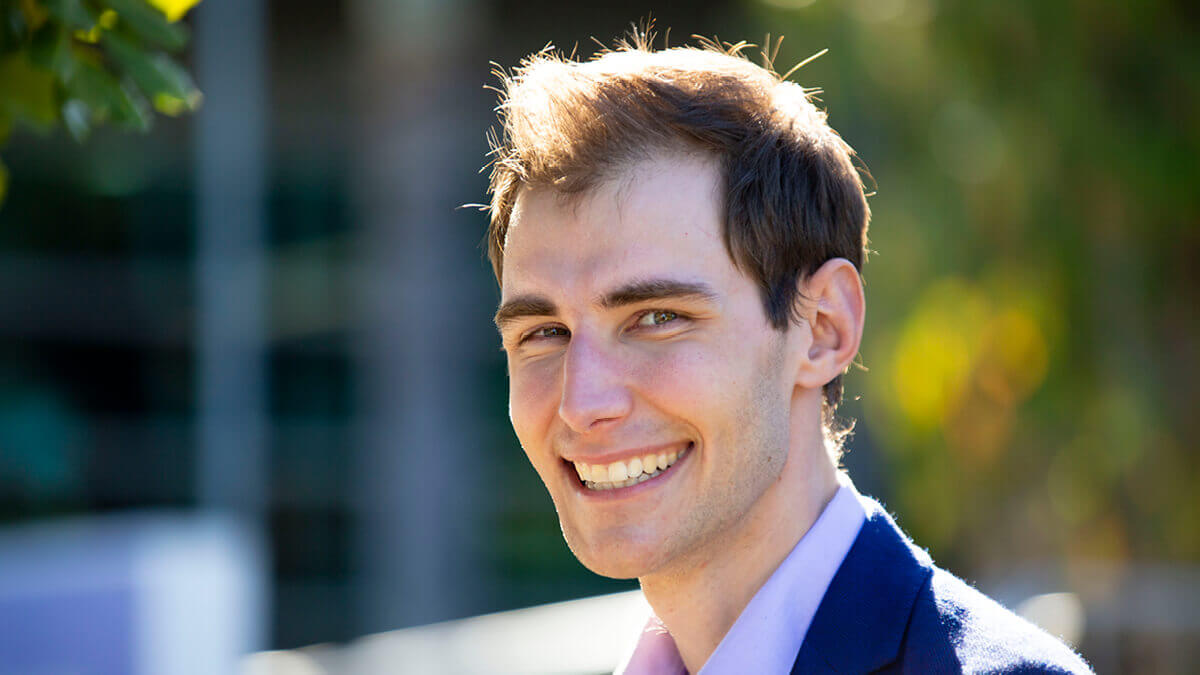
This is a picture of me. I called it ‘Real Estate Representation’ because I look like a house sales person. I had 114 photos taken of me one afternoon, and then I asked my colleagues to vote on the photo they liked best. This one won the vote – it’s a winning shot of my winning smile.
About me
Hi there, my name is Alex.
I’m a young man with autism and an intellectual disability, who works four days a week at the Endeavour Foundation Support Centre as a Marketing Assistant in mainstream employment with support. I used to be a supported employee and that was great too.
When they asked me to write this blog, I felt really honoured. I love to help give people a voice. It was the perfect opportunity to share my views on autism.
I hope that when you read this blog, you feel inspired by people with autism, you are more aware of the characteristics of autism and thankful that we live in a diverse and varied community.
More about me? Well, I play a reasonably high level of tennis in competitions specifically tailored for men and women with intellectual disability, and compete in mainstream fixtures weekly. I am very proud of myself.
Many people know me for my jokes. I like to tell jokes because it gives people a bit of fun in their day.
I also live semi-independently with support and absolutely love it.
How do you know if you have autism?
Here is how you might know if you have autism.
The way you know if you’ve got autism is that you’re often very delayed with speech, communication and the way you connect socially. There can also be a tendency not to participate in the same way that the mainstream population would. You can find it terribly hard to consider others and easy to think only about yourself most of the time, if not all the time.
It’s pretty easy to tell if you have autism when you find yourself:
- flapping uncontrollably, this is done with one’s hands and can be a result of emotional distress, thoughts and feelings
- humming beyond usual limits
- screaming and yelling at loud noises
- an inability to modulate your own audible sound levels.
Some people with autism can talk fluently, a certain percentage of people with autism have very limited talking ability, to being non-verbal. I have a great speech, which I hope you can see in this blog. A good indicator of your autism likelihood is your intellectual functioning (people with autism usually have some level of intellectual impairment). It’s a struggle when changes happen in life.
People with autism have interesting and exciting ways of thinking about life, participating in the activities they undertake and contributing to the roles in their occupation/ workplace.
Autism is just one diverse part of the community and society, people with autism make a hugely positive difference.
What does it feel like to have autism?
Having autism is challenging from the cognitive consideration of others and the awareness point of view. However, it’s rather cool from the thinking outside the box side of things. It’s a little difficult when it comes to controlling one’s voice modulation and humour sharing amounts. I have very high humour sharing amounts.
Having autism feels like a key to diversity, with the way we share our ideas for things, and the logistics we use while we’re working. It feels like a unique part of us.
Having autism does present extra behavioural challenges and social oddities, which the mainstream society doesn’t have, but makes for an awesome, different and varied society and community. People without autism must get to know people with it before they judge them.
Having autism is just one of our human components and adds to our qualities as a person. Having autism can make sporting teams tactically ahead of the pack, as the team members with autism have unusual outside-the-box strategic ideas.
What should people know about autism?
The main thing that people should know about autism is that it’s basically a condition that impedes/affects people’s behaviour and ability to communicate, socialise and consciously participate. People with autism mostly look at life and things from their own point of view and can have trouble considering others' views, feelings and boundaries. People with autism quite often can have decent amounts of anxiety and sensitivity, due to sounds, social activity and participation. People with autism can have various physical behaviours such as flapping, humming and thumb sucking.
In some cases autism can, over time, have less impact on people’s lives with early intervention and therapies, such as Speech Pathology and Occupational Therapy.
Although autism is a struggle, it can lead to outside-the-box thinking, which can be extremely useful when it comes to education and diverse workplaces. People with autism can have really rich, fulfilling and highly successful lives. They’re just as nice, useful, and an enjoyable part of society and community as the mainstream population.
In summary, let’s see People with Autism for the quality of person they are, and not the troubles they have.
Myths about autism
Earlier in the year, I helped out with a video project that looked at some myths about autism.
Here are the videos: