Refer a Client
 Locations
 Donate
 Lotteries


Learn how inclusive hiring can boost your business in an increasingly tough market.
Australian businesses are operating in one of the tightest labour markets in recent years, forcing many organisations to rethink how they attract and retain reliable workers.
Persistent skills shortages, high turnover in entry-level roles and escalating agency reliance are placing sustained pressure on operational budgets.
Then there is the need to navigate increased expectations around Environmental, Social and Governance (ESG) performance, social procurement and responsible employment practices – all while aiming to meet production targets and protect margins.
For many leaders and teams, the issue is no longer recognising workforce instability.
The real question is how to find a practical, sustainable solution that improves performance without making operations more complicated.
This is where inclusive hiring becomes a commercial strategy.

The Workforce Challenge Facing Employers
In logistics, warehousing, manufacturing and packaging facilities, workforce instability directly impacts margin. Consider the following:
- High turnover increases recruitment and onboarding costs
- Agency reliance inflates labour spend and reduces continuity<
- Inconsistent attendance affects productivity and shift coverage
Then, ESG and social procurement requirements add another layer of reporting.
Volume hiring alone is no longer solving the workforce challenge. Each time an employee exits, organisations lose operational knowledge, process familiarity and team cohesion.
In this environment, retention and workforce reliability are no longer just HR metrics; they are competitive advantages.

The Untapped Workforce: Capability-Based, Structured Employment
Inclusive hiring is often misunderstood as a compliance initiative or a Corporate Social Responsibility (CSR) add-on.
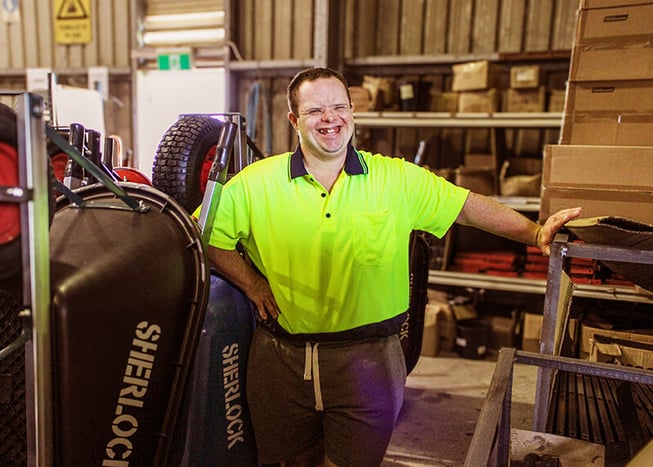
Yet when implemented correctly, it is a structured workforce strategy. Through Supported Hosted Employment, Endeavour Foundation works alongside businesses to design roles that align with operational workflows.
This can include carving jobs into group-specific tasks or filling specific positions within the organisation. It’s about capability-based employment built around:
- Clear, repeatable tasks
- Structured routines
- Defined performance expectations
- Practical, low-cost adjustments
In industries that rely on process discipline and consistency, this model fits naturally.
Employees are matched to roles based on the right skills and experience, with ongoing support to ensure they meet organisational targets – while giving managers confidence in the placement.
Where Inclusive Hiring Delivers the Strongest Results
Manufacturing, food processing, logistics and resource recovery environments often share similar characteristics, including:
- Step-by-step processes
- Checklist-based quality controls
- Repetition and predictable workflows
- Clearly defined zones and tasks
Tasks such as packing, labelling, portioning, quality checking, cleaning and dispatch support are well-suited to structured employment models.
Low-cost adjustments such as visual task cards, fixed shift patterns, buddy systems, colour-coded zones and ergonomic supports improve clarity and consistency for all workers, not just those with disability.
The result is often stronger accuracy, dependable attendance and reduced reliance on short-term labour – delivering measurable operational improvements that directly impact the bottom line.
Commercial Outcomes That Matter
Any workforce strategy should be evaluated through the lens of cost, productivity and stability.
Inclusive hiring consistently demonstrates measurable impact across these operational indicators.
Reduced Turnover
Entry-level retention improves when onboarding is structured and expectations are clear. Research shows that up to 20% of employee turnover occurs within the first 45 days, so a positive onboarding experience has a direct impact on productivity, retention and workplace safety.
Lower Recruitment Costs
A repeatable hiring pipeline reduces time-to-fill and ongoing agency reliance.
Stronger Attendance and Stability
Predictable rosters and clear role design support consistent shift coverage.
Improved Team Morale
Teams benefit from clearer processes and shared accountability.
Demonstrable ESG and Social Procurement Impact
Inclusive employment contributes to measurable social value outcomes increasingly relevant in government, infrastructure and large enterprise supply chains. Through our supported and hosted employment pathways, Endeavour Foundation partners with businesses to reduce risk at every stage – from role design and candidate matching through to onboarding and ongoing performance support.
The focus is simple: lift performance while building stronger communities.
Embrace Inclusive Hiring
Curious to see what an inclusive hiring strategy could look like in your operations?
For organisations facing ongoing turnover, workforce instability or increasing ESG expectations, inclusive hiring offers a practical way to strengthen both operational performance and social impact.
Book a discovery call with our expert team to explore your operational needs and identify where inclusive employment could make a difference in your workplace.
Take the first step today.