Refer a Client
 Locations
 Donate
 Lotteries
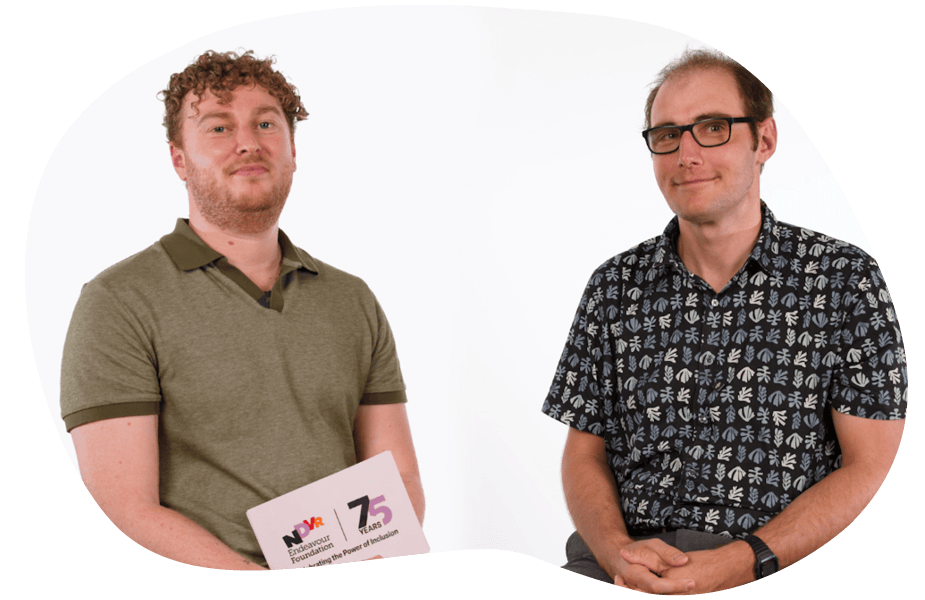
For World Autism Awareness Day, Endeavour Foundation team member Alex Baker sat down for an honest conversation about autism, inclusion, work, relationships, stereotypes and the misconceptions people still have today.
Here are some of the most insightful moments from the interview.
Q: What are some of the most annoying questions people ask you about autism?
“I suppose when I’m stimming, for example wringing my hands, people are like, ‘Are you okay?’ Quite often the answer will be, ‘Yeah, I’m just in the middle of an autistic phase.’
“There are a lot of assumptions made and a lot of looks when people are doing characteristic behaviours of autism. It can be uncomfortable having that attention when you’re just existing with autism and the things it makes you do.”
Q: Do all autistic people love trains?
“I tend to think it’s false.
“I’ve got a lot of autistic friends. They catch trains, but they’re not obsessed by them.
“It used to be an obsession of mine, but that’s faded away over time. Things autistic people may be obsessed with early on in life doesn’t necessarily mean they’ll be in the grips of that for the rest of their lives.”
Q: Does autism mean you don’t understand sarcasm?
“I can tell the difference.
“If it’s clear someone is saying something they don’t mean, that’s sarcasm. I think people with autism have just as much knowledge about sarcasm as the general population.”
Q: What does autism look like for you personally?
“I still find myself humming to an extent. The flapping is still there to an extent. The hand-wringing is still there to an extent.
“One classic trait of autism that I still must get better at is realising when I say something or keep talking about my topic, I can come across as self-absorbed or inconsiderate.
“It can be misinterpreted in different ways.”
Q: What is “not burning the toast”?
Alex attended an autism program that focused on social communication and understanding conversation balance.
“It’s basically not talking about a certain thing until people fall asleep and zone off,” he explained.
“It’s about giving the other person a chance, and it’s about equal communication.”
Q: How did your diagnosis change your life?
“With that diagnosis came the appropriate schooling.
“The noise was a big factor. I remember as a family having to leave social settings when machinery started. Hand dryers were a problem because of the noise factor.
“The diagnosis helped me get the supports I needed.”
Alex also said early intervention today is far better than when he was growing up.
“If your kid is showing traits of autism, get them checked out from a very young age and get the supports needed because there’s so much more available now.”
Q: Do you like having autism?
“One thing my autism does do is help me in my career.
“My job largely involves analysis, meticulousness and thinking outside the box. Quite a lot of the time I find myself coming up with new ways of doing existing tasks.
“We do talk in riddles a lot in ways people in the general population don’t, so it does have its perks.”
At the same time, Alex acknowledged some of the challenges that come with autism socially and emotionally.
“It would be preferable to function cognitively like the general population to enhance friendships, relationships and overall life.”
Q: What could workplaces do better for autistic people?
“Take the person on with a ‘what they can do’ attitude and cater as best you can for the difficulties they have.
“I think it’s about giving people with autism the opportunities they would have without it.”
Alex believes employers should focus more on strengths rather than deficits.
“People with autism, especially high-functioning autism, can think of things in exceptionally creative ways that can make your business absolutely flourish.”
Q: Why do so many autistic people struggle to find work?
“One of the problems is people are expected to do the whole job or not at all.
“That’s where there needs to be gradual progression.
“You get good at one thing and then get good at another thing.”
Alex said building confidence through smaller tasks can make a major difference.
“There is nothing better than doing one thing to perfection. It is so empowering.”
Q: Have you experienced discrimination?
“I was quite badly bullied in England as a kid.
“I think particularly in schools there’s a lot of discrimination, and if we’re not talking about discrimination, bullying is a really big thing.”
Alex said discrimination often comes from misunderstanding and people focusing on differences rather than strengths.
“People think, ‘They’re different, strange, funny,’ and single them out.”
Q: Is making eye contact difficult?
“There’s no doubt about it, I’ve struggled with eye contact.
“I think autism tends to pull people into their shell a lot. Sometimes it’s difficult for people with autism to actually look at people.”
At the same time, Alex pointed out that eye contact is not the only way people communicate.
“There are other ways. Facial cues, body language and things like that.”
Q: What is your least favourite representation of autism in media?
“I struggle with the idea that every single person with autism is rigid and exactly the same.
“This cognitive challenge affects people in different ways.”
Alex said autism is too complex and varied to fit neatly into one character or stereotype.
“Not everybody is Sheldon Cooper.”
Q: What would you say to people who are not autistic?
“If you were thinking of criticising people who have intellectual impairment, autism or any disability, flip the situation around and imagine if it was you.
“Please treat us the same way as you’d want us to treat you.”
Q: What do you want society to understand about autism?
“I would like society to welcome people in and not have barriers or walls up that don’t necessarily need to be there.
“People with autism have just as much right to work in a job they want to get up for every day.
“They have a right to participate in activities they wish to undertake.
“They have a right to learn anything they can cognitively learn.”
Building More Inclusive Workplaces
To learn more about how Endeavour Foundation is helping businesses build more inclusive workplaces and create meaningful employment opportunities for people with disability, explore our inclusive hiring resources.